
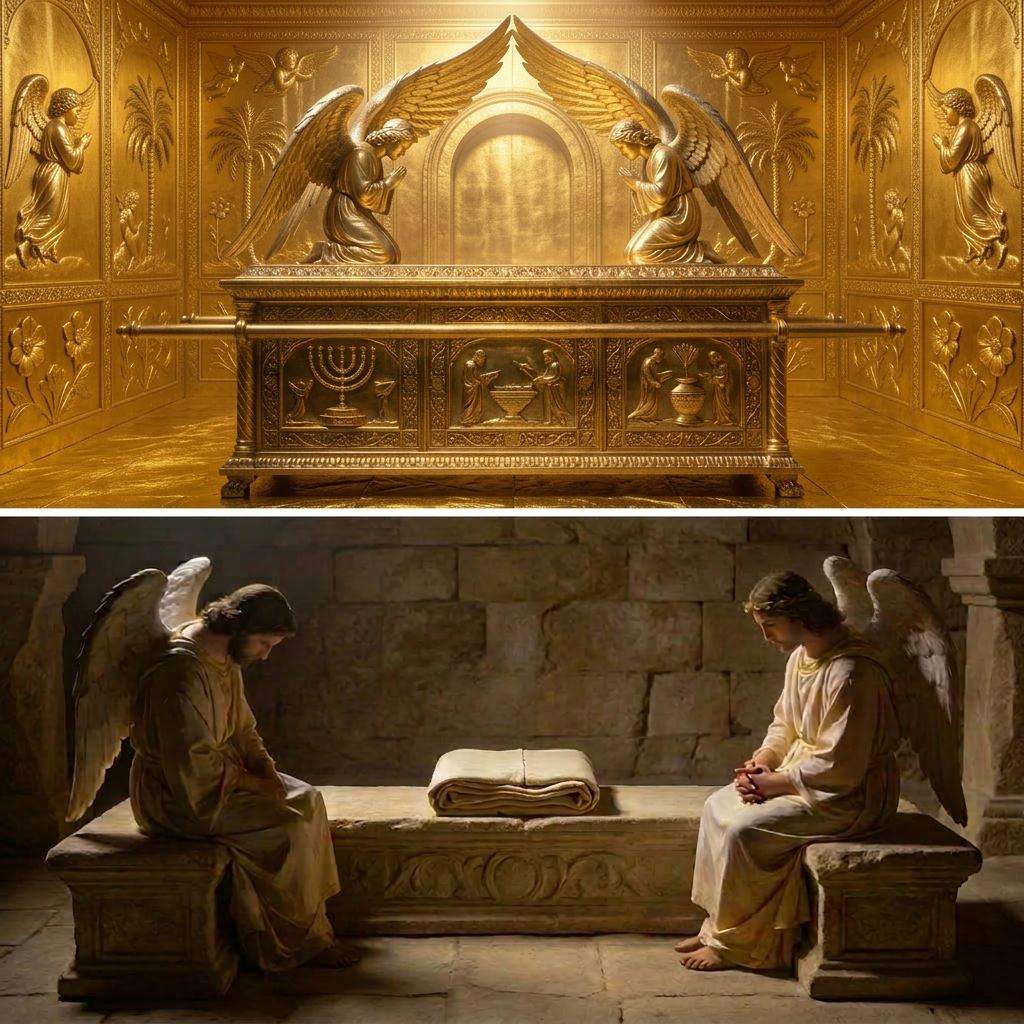
The Ark of the Covenant and the empty tomb share striking symbolic parallels, each revealing God’s presence, mercy, and resurrection power.
Biblical Foundation
Exodus 25:20 describes the Ark’s cherubim with wings stretched upward, overshadowing the mercy seat and facing one another, forming a throne for God’s glory. In Gospel of John 20:12, Mary sees two angels in white, one at the head and one at the feet where Jesus’ body had been. The symmetry is intentional, nothing in Scripture is incidental.
Visual Symbolism
Picture the Holy of Holies, its gold-covered walls enclosing the Ark, cherubim overshadowing the mercy seat. Now consider the tomb, where two angels flank the place where Jesus the Christ lay. One scene guards the place of atonement, the other reveals it fulfilled. Both frame a meeting point between heaven and earth. Atonement means making things right between people and God after sin creates a separation. Hebrew root (kaphar): Literally “to cover” sin, like a debt paid or stain wiped clean. The same word Noah was told to cover the ark with “pitch – kaphar,” Genesis 6:14.
Everyday picture: You break a vase (sin), pay to fix it (sacrifice), and get forgiven (reconciliation).
Scriptural Ties
The Ark held the Law and was the place of atonement. The tomb held the One who fulfilled both. In Book of Genesis 3:24, cherubim guarded Eden, restricting access to life. In the resurrection, angels no longer guard but announce, signaling restored access through Christ. Both scenes draw attention to reconciliation. Reconciliation (Greek: katallagē, καταλλαγή) means changing from enemies to fellowship; restoring a broken relationship, our ministry 2 Corinthians 5:18.
The Ark contained the tablets of the covenant, manna, and Aaron’s rod, each pointing forward to provision, authority, and life. Its lid, the mercy seat, was where blood was sprinkled on Yom Kippur for atonement, foreshadowing the sacrifice of Jesus Christ.
Crafted from acacia wood, the Ark reflected durability and incorruptibility, overlaid with pure gold. This duality points to Christ’s nature, fully human and fully divine. The same wood, native to the Sinai region, may be reflected in the “thicket” of Book of Genesis 22:13, where the ram was caught, a provision in place of Isaac.
The Hebrew word “sevakh” describes a dense, tangled thicket of thorns, echoing the crown placed on Christ in Gospel of John 19:2. What once symbolized substitution now culminates in fulfillment.
Together, the Ark and the empty tomb present a unified message, mercy has been given, the Law fulfilled, and access to God restored. Animal blood “covers” sins temporarily on the mercy seat (Leviticus 16:14). Jesus provides permanent atonement through His blood (Romans 3:25).
Remember these intertwined facts when you celebrate His Resurrection Day!