
Just as a pile of loose, scattered bricks isn’t a house, information is only useful when it is organized into a clear, meaningful pattern. Without that structure, it is indistinguishable from the background noise of the universe.
DNA is an instruction book inside every living thing that tells the body how to grow, work, and look. DNA might look simple in pictures, but it holds an incredible amount of information inside every living thing. To really appreciate it, we must go just a little deeper than the basics, not to learn every tiny detail, but to see how much is already known about this powerful molecule. If you hang in there, the results will astonish you. Or you can just skip to the end. 😊
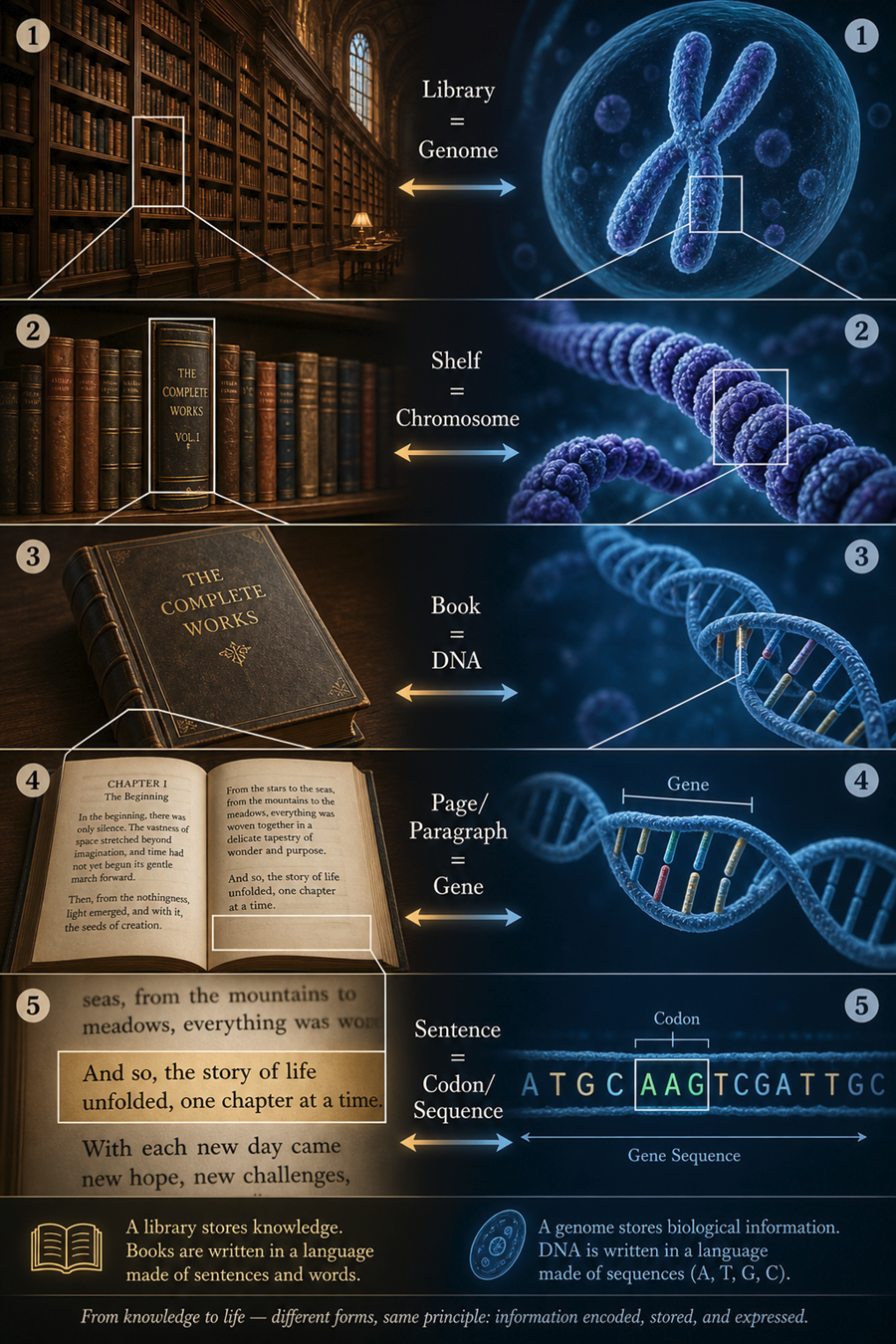
Imagine you inherit two huge libraries, one from each parent, and those two sets are combined into a single, new library that is uniquely yours. Each shelf in this library is like a chromosome, and on the shelves are very large “books” we call DNA. DNA is written with just four chemical “letters,” and the order of these letters matters, the way the order of letters matters in words of any language. Small groups of these letters, usually in sets of three, can be thought of as short “words” that the cell reads when it is building something. Longer stretches of DNA are called genes, and a gene is like a complete sentence or a recipe in a cookbook, because each gene gives a full set of instructions for making one specific protein.
Proteins are the things your cells actually build by following those recipes. You can picture proteins as the tools, machines, and building materials in your body, as well as some of the “glue” and scaffolding that hold structures in place. Some proteins form the fibers in your muscles and hair, others act like tiny machines that speed up chemical reactions, and others help organize and package the DNA itself, a bit like the bindings, bookends, and support beams that keep the library in order. When the two parental libraries are combined, the particular mix of shelves, books, and recipes, and how they are used over your lifetime, creates a one of a kind “story” of how your body is built and how it works, which is what makes you you.
David sums it up in Psalms 139:14, “I will give thanks to You, for I am fearfully and wonderfully made. Your works are wonderful. My soul knows that very well.”
The language most often cited as having the smallest alphabet in the world is Rotokas, spoken on Bougainville Island in Papua New Guinea. Its writing system uses just 12 letters, a subset of the Latin alphabet, which is fewer than Hawaiian’s 13 letters.
To see the awesomeness of God, we need to get into details so you can see how all of this is planned out, not by chance, and see that the magnificence of God’s word.
DNA in every cell is like a vast library book, written in a four-letter language: A for adenine, C for cytosine, G for guanine, and T for thymine. These letters pair up perfectly, A with T, G with C, like puzzle pieces snapping together with hydrogen bonds (like glue) to twist into the famous double helix ladder.
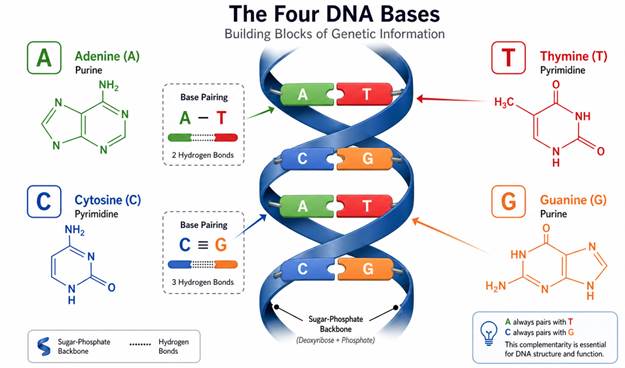
Atoms Used
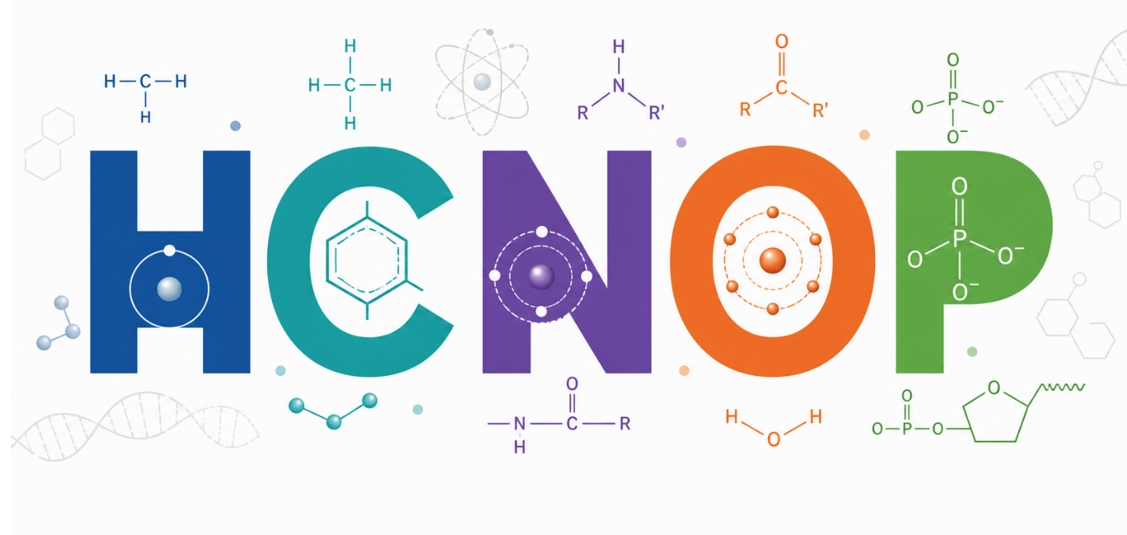
Each letter is built from just five basic atoms: hydrogen (H), carbon (C), nitrogen (N), oxygen (O), and phosphorus (P), with phosphorus forming the base, the scaffolding backbone in the image above. Nothing random here; it’s a precise code of instructions cells read to make proteins and pass traits, just as deliberate as words on this page.
Here is the nerdy illustration that captures a simple explanation for a very complex process. Each letter is an atom.
The picture shows that each atom has a “profile” with its own built‑in stats, such as how many protons, neutrons, and electrons it has, how heavy it is, and how it behaves. Even the shapes of the atoms are important.
The most common atoms that make up our DNA are almost exclusively composed of Hydrogen (H), Carbon (C), Nitrogen (N), and Oxygen (O).
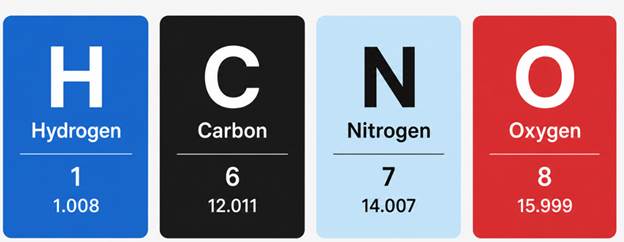
The number of protons is the atom’s ID number, it tells you which element it is, like hydrogen (1), carbon (6), nitrogen (7), and oxygen (8).
So, just like a character in a game has strength, speed, and health, each atom has its own set of stats, things like proton count, neutron count, electron count, mass, and charge, and those stats decide what kind of element it is and how it acts.
Notice the numbers at the bottom of each element. These numbers are the atomic weight for each element. Atomic weight is a number that tells you how heavy an average atom of an element is compared with other elements on the periodic table.
By now, I’m sure your head is hurting and this is giving you flashbacks to not only math, but biology and chemistry classes. But bear with me, the explanation is needed to show the Author’s signature.
Alphabetic Numerals
Aramaic, Greek, and Hebrew do not use symbols to communicate numbers, but repurpose their alphabet. For example, A=1, B=2, C=3, etc. This system, called alphabetic numerals, enables historical counting without distinct symbols. Roman numerals use partial letters to depict numbers. For example, only select letters (I, V, X, L, C, D, M) have values, not the full alphabet in sequence. The number 1776 is written MDCCLXXVI. Happy Birthday America!
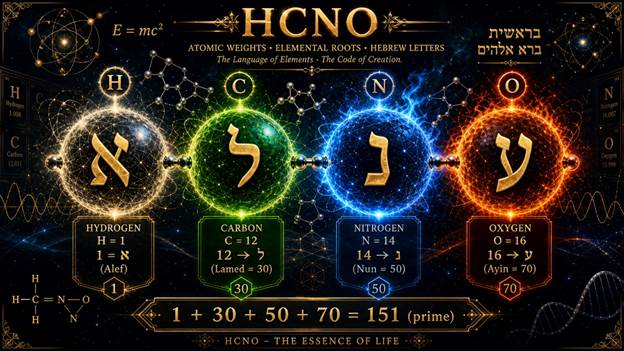
If we use the atomic weight values and map them onto Hebrew letters, we arrive at the combination shown in the next image.
Like hieroglyphics, each ancient Hebrew letter carries meaning. Paleo Hebrew chart: (https://abdicate.net/i/paleo-hebrew-chart.png)
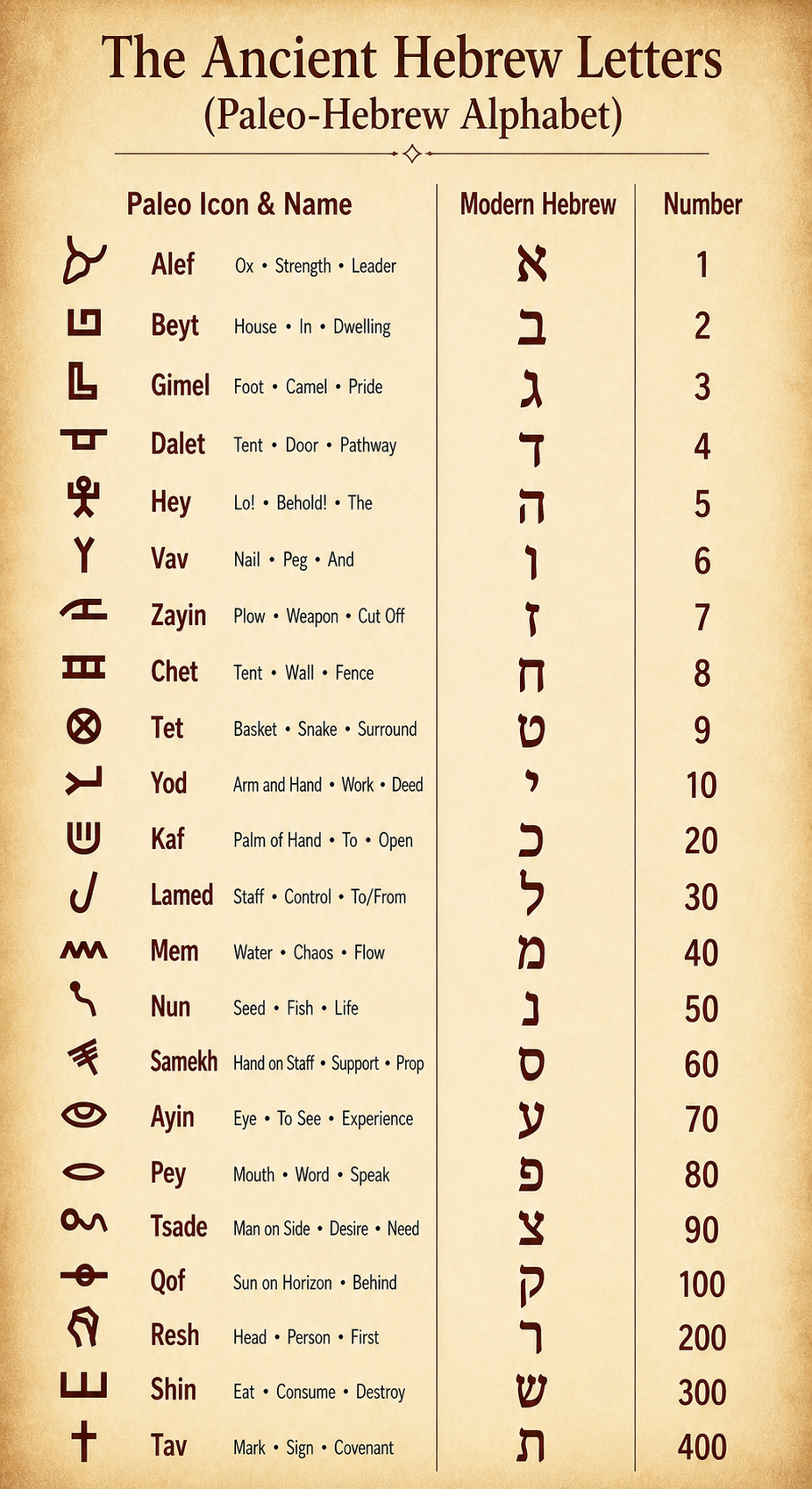
- ע (Ayin), the Eye, represents vision, perception, and understanding. Romans 1:20, Ephesians 1:18, Joel 2:28
- נ (Nun), the Seed, represents offspring, faithfulness, and continuation. Psalm 89:36
- ל (Lamed), the Shepherd’s Staff, represents authority, instruction, and guidance. Proverbs 3:19, Proverbs 15:33, Daniel 12:4
- א (Alef), the Ox Head, represents strength, sacrifice, leadership, and the Mighty One. Romans 10:9-10, Revelation 1:8, Revelation 13:8
The last two letters אל is translated as “God”. Together, the sequence forms a powerful picture:
“The faithful perceive the guidance of the Mighty One.” 1 John 2:27
The Hebrew word for humility, ענוה (‘anavah), shares the root ענ, connecting humility with perception and faithful response. God gives vision to the humble. Habakkuk 2:2-3, Acts 18:9, Genesis 15:1
Therefore, the sequence can also be viewed as a blueprint of life itself:
- Alef, the Source, the originating spark of existence. John 1:1
- Lamed, the Framework, the structure that gives form. Ephesians 4:16
- Nun, the Information, the seed carrying life forward. Jeremiah 31:33
- Ayin, the Perception, the ability to see and interact with creation. Hebrews 8:10, 10:16
Even the foundational elements of biology align remarkably with this pattern:
- Hydrogen (Alef), the fundamental beginning.
- Carbon (Lamed), the structural backbone of life.
- Nitrogen (Nun), essential to genetic information.
- Oxygen (Ayin), tied to breath, perception, and living awareness.
The Conclusion
Creation itself declares order, meaning, and design. The “Eye” witnessing the “Seed” under the authority of the Mighty One points ultimately to life as testimony of the divine image and the Son of God revealed in flesh. See Son [of] God.
Psalms 19:1-14
The heavens declare the glory of God, and the sky above proclaims his handiwork. Day to day pours out speech, and night to night reveals knowledge. There is no speech, nor are there words, whose voice is not heard. Their voice goes out through all the earth, and their words to the end of the world. In them he has set a tent for the sun, which comes out like a bridegroom leaving his chamber, and, like a strong man, runs its course with joy. Its rising is from the end of the heavens, and its circuit to the end of them, and there is nothing hidden from its heat. The law of the LORD is perfect, reviving the soul; the testimony of the LORD is sure, making wise the simple; the precepts of the LORD are right, rejoicing the heart; the commandment of the LORD is pure, enlightening the eyes; the fear of the LORD is clean, enduring forever; the rules of the LORD are true, and righteous altogether. More to be desired are they than gold, even much fine gold; sweeter also than honey and drippings of the honeycomb. Moreover, by them is your servant warned; in keeping them there is great reward. Who can discern his errors? Declare me innocent from hidden faults. Keep back your servant also from presumptuous sins; let them not have dominion over me! Then I shall be blameless, and innocent of great transgression. Let the words of my mouth and the meditation of my heart be acceptable in your sight, O LORD, my rock and my redeemer.
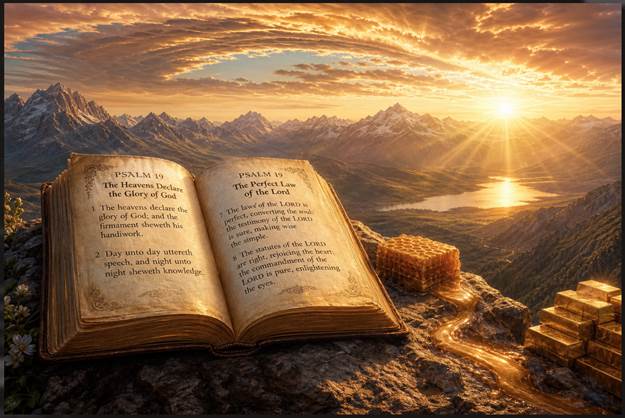
The word of God which is sweet as honeycombs and full of riches greater than gold.