
Genesis 1:2, “…and the Spirit of God moved upon the face of the waters.”

Some Bible translations say “moved.” Others say “hovering.” But what if both of those words barely scratch the surface of what the original Hebrew is actually saying?
The word hiding behind those translations is רָחַף, rachaph (pronounced “ra-KHAF”). And once you understand what it really means, the way you read Genesis 1:2, and maybe even what it means to be a Christian, may never be quite the same.
A Word That Does More Than Move
In Hebrew, rachaph isn’t just about something floating around in the air. It carries a whole range of meanings, and together they paint a picture that’s far more alive and intentional than “moved” suggests.
At its most basic level, the word means to grow soft or to tremble. In Jeremiah 23:9, it’s used to describe bones shaking under the weight of overwhelming grief or fear, a kind of internal melting when something powerful takes hold of you.
But in its more intense form (what Hebrew scholars call the Piel stem), the word shifts into something warmer and more purposeful. In Deuteronomy 32:11, it describes an eagle hovering over her young, not drifting lazily, but actively, deliberately fluttering above her nest to stir her babies into flight. She’s watching over them. Warming them. Stirring life in them.
And then there’s Genesis 1:2, where the Spirit of God is described doing this very thing, hovering, brooding, moving, over the face of the waters.
This isn’t random movement. This is the Creator leaning in.
What the Ancient Letters Say
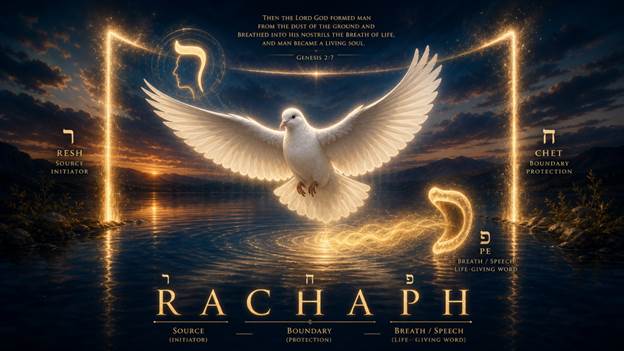
In Paleo-Hebrew (an older form of the language where every letter was actually a picture), the three letters of rachaph each tell a piece of the story:
Resh (ר), A picture of a head. It represents the source, the leader, the one who initiates.
Chet (ח), A picture of a fence or wall. It represents a boundary, a protected, enclosed space.
Pe (פ), A picture of an open mouth. It represents breath, speech, the act of sending something outward.
Put them together and you get this picture: A source of power creates a protected space by breathing into it.
That’s not just movement. That’s intentional, life-giving action. The Creator leans over what is empty or dormant, surrounds it with care, and breathes something into it that wasn’t there before. Genesis 2:7.
#HolySpirit, #SpiritLed, #SpiritAndLife, #WalkByFaith, #LifeInTheSpirit, #SpiritualGrowth, #ChristianLife
The Pattern Shows Up Everywhere
Here’s where it gets interesting. Once you see what rachaph is actually describing, you start to notice the same pattern repeating all over the place, in nature, in Scripture, and in human experience.
The bird and the egg. A bird doesn’t just lay eggs and walk away. She hovers. She settles over them, covering them with her body, keeping them warm. Without that steady, close, protective presence, the life inside the egg never wakes up. The hovering is the life-giving.
The seed in the ground. A seed sitting in dry, hard soil looks completely dead. Nothing seems to be happening. But when moisture soaks in and warmth reaches it, the hard outer shell begins to soften, and something that looked lifeless starts to grow. The same word (rachaph) that means “to hover” also means “to grow soft.” That’s not a coincidence.
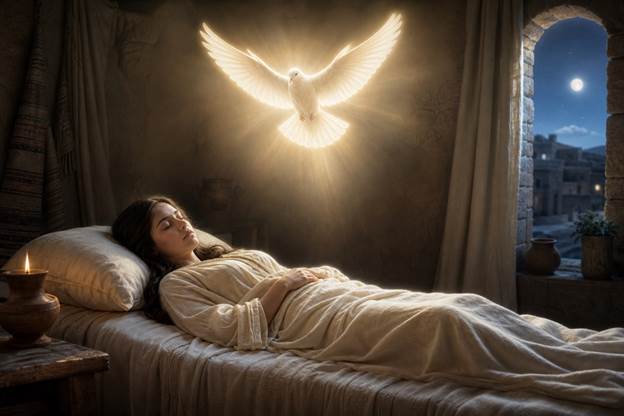
The Proclamation. When the angel tells Mary that the Holy Spirit will “come upon her,” there’s a quiet echo of Genesis 1:2 in that moment. The same Spirit that hovered over the dark, formless waters at the beginning of creation is now hovering over a human womb, and life that couldn’t exist by natural means comes into being. A passive, waiting vessel. An active, life-giving Spirit. The same ancient pattern.
Is that a stretch? Honestly, no. It’s the same God using the same method. The container is different each time, but the act of hovering and bringing forth life is the same.
What This Has to Do with Being “Born Again”
This is where the Old Testament word and the New Testament’s good news start talking to each other in a way that’s hard to ignore.
Take three verses together:
Romans 4:17, “God…gives life to the dead and calls into existence the things that do not exist.”
This is Genesis 1:2 happening again. The Spirit hovers over what is dead or empty and speaks life into it. Not a renovation, a creation.
2 Corinthians 5:17, “If anyone is in Christ, he is a new creation. The old has passed away; behold, the new has come.”
The “old things” are the hardened, stuck, broken patterns of who we used to be. Like the seed’s tough outer shell that has to soften before anything can grow, the old self has to give way. You don’t just get a better version of yourself, you get something entirely new.
1 Peter 1:3, “He has caused us to be born again to a living hope through the resurrection of Jesus Christ from the dead.”
The same Spirit that raised Jesus from the dead is the Spirit that hovers over every person who comes to faith. The resurrection isn’t just a historical event, it’s the pattern. Death giving way to life. Dormancy giving way to awakening.
Taken together, these verses describe what happens when someone becomes a Christian not as a decision made and checked off, but as a birth, something that happens to you, in you, because a power greater than you leaned in close and breathed life into what was empty or dead. 1 Corinthians 15:45, John 5:21, John 6:63, Romans 8:11.

The Caterpillar in the Cocoon
If you want a picture from the natural world that captures all of this in one image, look no further than what happens inside a cocoon.
The caterpillar doesn’t just grow wings. It goes through something far more dramatic, and far more unsettling. Once sealed inside the chrysalis, it essentially dissolves. Its body breaks down into a kind of living liquid. Everything that made it a caterpillar, its structure, its form, its way of moving through the world, comes completely undone.
But hidden within that liquid are tiny cells that were always there, waiting. When the conditions are right, those dormant cells begin to receive what they need to assemble something entirely new. And what emerges isn’t an improved caterpillar. It’s a butterfly, a creature that inhabits a different dimension, eats different food, and exists for a completely different purpose.
Think about that alongside what rachaph describes:
The chrysalis is the protected enclosure, the Chet, the fence, the safe space where transformation can happen without interference.
The liquefaction is the “growing soft”, the painful, surrendered letting-go of the old self. Romans 6:6
The dormant cells waking up is the breath of life, the Spirit moving over what seemed dead and calling it into something new.
And the butterfly? That’s 2 Corinthians 5:17. The old has passed away. The new has come.

What It All Points To
The word rachaph is doing something that one English word can’t carry on its own. It’s describing the consistent way God works, hovering close, creating a protected space, softening what is hard, and breathing life into what is dormant or dead.
It shows up at the beginning of creation.
It shows up in the life of a seed.
It shows up in the warming of an egg.
It shows up at the Proclamation.
It shows up in the resurrection.
It shows up every time someone is truly “born again.”
The mechanics are always the same: there is something passive and waiting, waters, a womb, a seed, a soul. And there is an active, hovering Presence that leans in, breathes, and brings forth something that couldn’t come to life on its own.
To be a Christian, in the fullest sense of that word, is to be someone that the Spirit of God has hovered over, someone whose hardened places have been softened, whose old self has been dissolved, and whose new life has been breathed into existence by the same power that moved over the waters at the dawn of creation.

That’s more than “moved.”
That’s everything.